
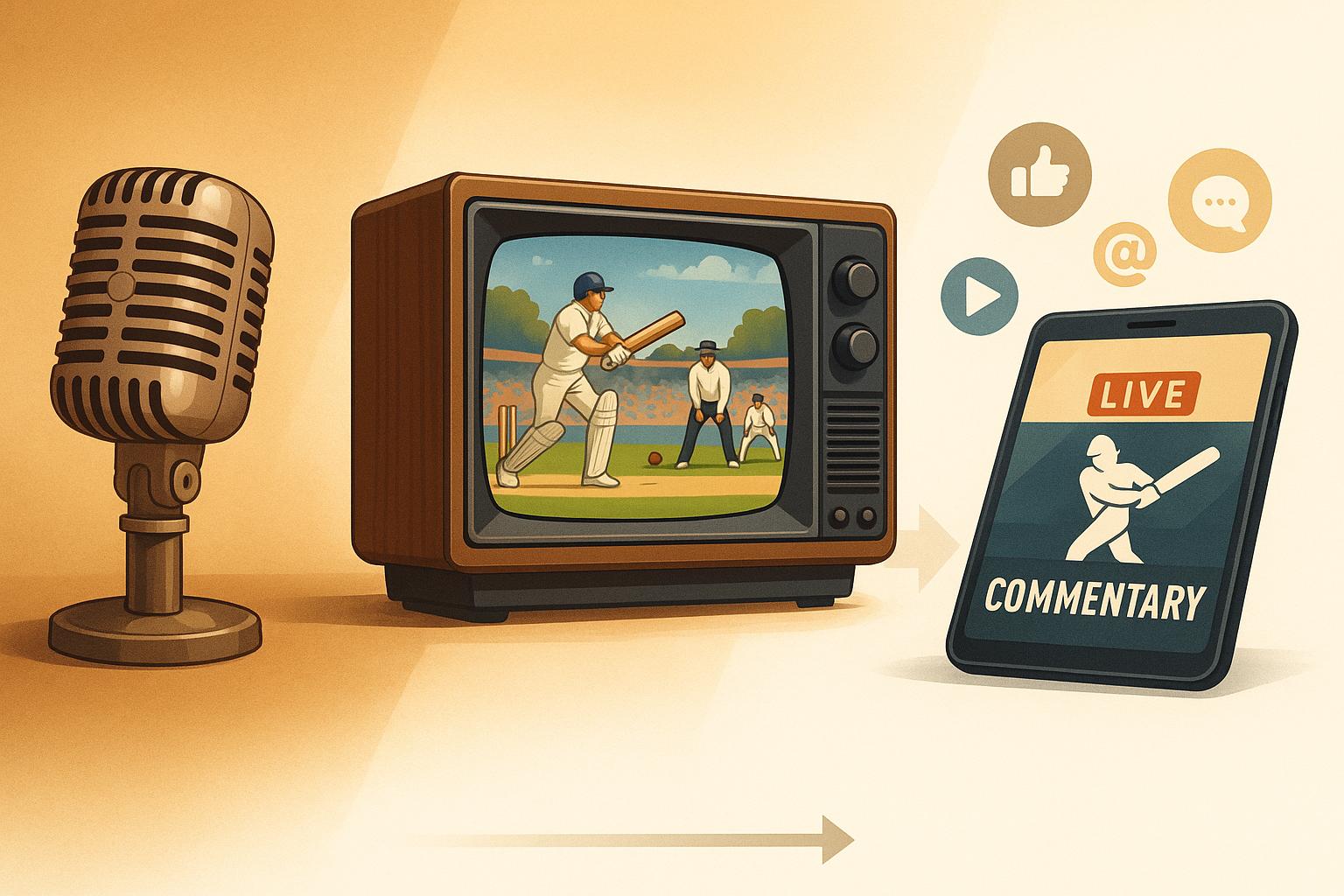
Test cricket commentary has transformed dramatically since its beginnings in the 1920s. Early radio broadcasts focused on detailed, formal descriptions to help listeners picture the game. The introduction of television in the 1950s shifted the focus to analysis and context, as visuals eliminated the need for purely descriptive commentary. Today, modern technology, like real-time stats, augmented reality, and player tracking, has added depth and interactivity, making commentary more engaging and informative.
This evolution reflects changing audience demands – fans now expect a mix of tactical breakdowns, storytelling, and humor. Digital platforms, multilingual options, and data-driven insights have expanded cricket’s global reach, ensuring commentary stays relevant in a rapidly changing media landscape.
‘Synthetic’ cricket commentary brought international test matches home | RetroFocus | ABC Australia

Radio Commentary: Telling Stories Without Pictures
Radio commentary was cricket’s first big leap into mass media, challenging broadcasters to turn the game’s visual drama into gripping audio narratives. These early efforts didn’t just entertain; they shaped how modern commentary evolved.
First Radio Cricket Broadcasts
The journey began in 1927 with live cricket broadcasts. These early experiments saw commentators figuring out how to transform the visual spectacle of cricket into a compelling audio experience. Howard Marshall, for instance, transitioned from simple updates to delivering full-fledged commentary. A major milestone came in 1939 with the introduction of experimental ball-by-ball coverage. This format was perfected with the launch of Test Match Special in 1957, which quickly became the benchmark for cricket commentary on the radio.
Famous Radio Commentators
As radio commentary matured, certain voices became synonymous with the craft. John Arlott, a commentator from 1946 to 1980, stood out for his poetic descriptions and ability to create vivid mental images for listeners. Known for his humor, Arlott once quipped during a match:
"We’ve got a streaker down the wicket now, not very shapely and it’s masculine. And I would think that it’s seen the last of its cricket for the day."
Brian Johnston, another iconic figure, charmed audiences with his lighthearted and humorous style during his career from 1966 to 1994. Meanwhile, E.W. Swanton and Rex Alston mastered the art of crafting intricate "word pictures", ensuring their audiences felt as if they were right there at the match.
Keeping Radio Audiences Interested
Without visuals, radio commentators had to work harder to keep listeners hooked. They didn’t just narrate the action; they painted the entire scene – from the bowler’s approach to the subtle shifts in the crowd’s mood. During slower moments, storytelling became essential. Anecdotes, historical tidbits, and even weather updates were woven into the commentary to maintain engagement. The conversational tone made listeners feel like they were chatting with a well-informed friend. Richie Benaud, a celebrated commentator, summed it up perfectly:
"My mantra is: put your brain into gear and if you can add to what’s on the screen then do it, otherwise shut up. The key thing was to learn the value of economy with words and to never insult the viewer by telling them what they can already see."
These pioneering radio commentators didn’t just entertain – they revolutionized how cricket was shared with audiences. Their storytelling techniques laid the foundation for the detailed, immersive commentary styles we see today on television and digital platforms.
Television Commentary: Adding Pictures and Analysis
Television transformed sports commentary, shifting the focus from descriptive storytelling to in-depth tactical analysis. Unlike radio, which relied on vivid verbal imagery to paint pictures for listeners, television allowed commentators to delve into the "why" behind the action. With visuals already on screen, their role evolved into explaining strategies and breaking down the nuances of the game.
How Television Changed Commentary
The transition from radio to television brought a fundamental change in how commentators approached their craft. Radio required them to describe every detail to create a mental image for the audience. Television, however, provided those visuals, freeing commentators to explore the tactical and strategic elements of the game. Since its introduction in the 1930s and the widespread adoption of color TV in the 1970s, television commentary began to focus on field strategies, player techniques, and decision-making processes.
A major turning point came in the late 1980s with the rise of satellite television. Networks like Sky Sports began investing in cutting-edge technology and assembling expert commentary teams, elevating the viewing experience. Advanced cameras, interactive features, and behind-the-scenes content became staples, making broadcasts more engaging and insightful.
Today, modern technology like Hawkeye and UltraEdge has revolutionized commentary further. These tools integrate live analytics, offering viewers real-time data and visuals that enhance understanding. Augmented reality overlays now bring statistics and tactical insights directly to the screen, adding depth to the analysis. This evolution has also opened the door for former players to bring their firsthand knowledge into the commentary box.
Former Players Join Commentary Teams
The shift toward analysis created opportunities for retired cricketers to join commentary teams. Their experience allows them to break down the mental and physical aspects of the game in ways that resonate with audiences. They can explain the psychological challenges of facing a particular bowler, interpret subtle field changes, and provide insights into pitch conditions – all of which enrich the viewer’s understanding.
Ben Jones, Head of Insight at CricViz, highlighted the importance of technology in aiding commentators:
"Commentators can’t be across every player. Being able to search an uncapped Bangladeshi right arm seamer and immediately access all the cricket they’ve ever played professionally, watch video of them, and get a sense of who they are is invaluable."
This blend of player expertise and data-driven insights has bridged the gap between traditional narration and modern, analytical commentary.
Top Television Commentators
Richie Benaud set the gold standard for television commentary with his ability to balance expert analysis and entertainment. His concise, insightful approach became a model for others, showing that television required a unique skill set distinct from radio.
Over time, commentary evolved to match changing audience expectations. What began as straightforward reporting transformed into colorful, engaging presentations. Commentators themselves became household names, celebrated for their ability to inform and entertain.
Today, television broadcasts cater to global audiences with multilingual commentary, reflecting cricket’s widespread appeal. The inclusion of real-time data and analytics has become essential, especially for attracting younger viewers. Michael Kivido, Managing Director at CricViz, explained:
"The new audiences that are coming to cricket, and cricket wants to attract, are used to consuming content in a very different way to how previous generations were. It’s an expectation to have data driven insights in the broadcast, and so to capture those audiences you have to meet that expectation."
Television commentary continues to thrive by blending visual storytelling with expert analysis, creating a dynamic experience for viewers. This evolution has laid the groundwork for even more advanced commentary styles as digital platforms and data analytics take center stage.
sbb-itb-3e44755
Technology and Data in Modern Commentary
Test cricket commentary has embraced cutting-edge technology, incorporating high-definition visuals, augmented reality (AR), and real-time analytics to deliver richer insights and keep audiences engaged. These advancements have reshaped how fans experience the game, blending traditional storytelling with modern tools.
New Broadcasting Technology
The use of high-definition visuals and AR has revolutionized cricket commentary, making it more dynamic and immersive. AR now enables live player tracking and interactive visual overlays, offering fans a clearer understanding of game strategies as they unfold.
A standout example occurred during the ICC World Test Championship Final 2021 in Southampton, UK. Quidich Innovation Labs introduced the Quidich Tracker (QT) system, powered by Vizrt‘s Extended Reality Suite. This system created a 3D digital twin to display real-time player positions, movements, and key statistics – a first in cricket broadcasting.
"There’s been a lot of bowler and batsman data that’s been available to viewers over the years, but this is the first-time fans have access to live player positional data, to really understand the complete strategy of the fielding team." – Rahat Kulshreshtha, CEO and co-founder of Quidich
Beyond player tracking, broadcasters have pushed the boundaries of AR to enhance storytelling. Hotstar, for instance, introduced a virtual set with AR graphics for its IPL coverage, using Vizrt technology to provide unique analysis and player statistics. This development has opened up new possibilities for how cricket is presented in studios.
"The new virtual set and the Vizrt graphics tools give us endless possibilities for how we can cover professional cricket with AR and VR in the studio." – Viraj Verma, Senior VP at Star Sports and Head of the Studios and Production
These innovations have contributed to what Kulshreshtha calls the "gamification of live television", offering fans perspectives and visualizations that were once unimaginable.
Live Statistics and Data
Real-time analytics have become a cornerstone of modern Test cricket commentary, allowing commentators to deliver detailed insights into the game. With live data feeds, they can analyze player performance, compare stats, and identify trends as matches progress, giving viewers a deeper understanding of the action on the field.
The ICC has implemented advanced data systems that process updates every 20 seconds. These systems provide a wealth of information, including player profiles, performance stats, and match conditions, all of which are accessible to commentators in real time. This data-driven approach has elevated commentary from descriptive play-by-play to strategic analysis based on live scenarios.
Platforms like Cricbuzz have embraced this data revolution, offering fans detailed player insights, live stats, and predictive analytics. These features allow commentators to break down tactical decisions and explain how game strategies evolve in real time. The integration of such analytics has redefined cricket commentary, making it as much about strategy as it is about storytelling.
Digital Platforms and Global Audiences
Digital platforms have expanded the reach of Test cricket commentary, bringing the game to a global, on-demand audience. These platforms offer personalized experiences with interactive features that keep fans engaged, no matter where they are.
Disney+ Hotstar set a new standard, attracting a peak viewership of 35 million during the 2023 ICC World Cup match between India and Pakistan. Similarly, the ICC launched its streaming service, ICC.tv, in 2021 to reach fans in regions without broadcast partnerships. By offering free access to matches via its website and app, the ICC has made cricket more accessible than ever.
Social media has further amplified cricket’s reach, enabling fans to engage with the game beyond live broadcasts. Platforms now support fan-driven commentary and demographically tailored content, reflecting the global and diverse nature of cricket’s audience.
"As the world becomes increasingly more global, a one-size fits all approach to sports broadcasting is no longer relevant. Demographically targeted commentary is a win-win for both fans and broadcasters." – Greg Norman
Digital platforms also offer the convenience of on-demand viewing, catering to the growing shift toward online sports consumption. This shift has reduced the dominance of traditional radio commentary while creating new opportunities for interactive, personalized cricket experiences. These innovations continue to transform Test commentary, blending traditional elements with modern, tech-driven storytelling.
Changing Audience Expectations and Commentary Styles
Advancements in technology have reshaped how cricket commentary is delivered, but audience expectations have been just as influential. Modern cricket fans demand much more than a simple play-by-play. With the shift from radio listeners to digital-savvy viewers, commentators have had to rethink their entire approach to covering Test cricket.
From Storytelling to Analysis
Gone are the days when commentary was just about narrating the action. Today’s audiences expect deeper insights – breaking down strategies, examining tactics, and understanding why certain decisions are made on the field. This evolution mirrors the broader changes in how fans consume cricket content, influenced heavily by television and digital enhancements.
Michael Kivido, Managing Director at CricViz, highlights this shift in audience behavior:
"The new audiences that are coming to cricket, and cricket wants to attract, are used to consuming content in a very different way to how previous generations were."
To meet these demands, commentators now rely on advanced data tools that provide instant player insights. Ben Jones, Head of Insight at CricViz, explains how these tools are indispensable:
"Commentators can’t be across every player. Being able to search an uncapped Bangladeshi right arm seamer and immediately access all the cricket they’ve ever played professionally, watch video of them, and get a sense of who they are is invaluable."
CricViz, for example, develops metrics specifically designed for broadcast, as Fred Clarke, the company’s product director, explains:
"A big part of what we’re trying to do is use data science to come out with new metrics that help explain what’s happening in the game, and to try to present that in as simple a way as possible so that the average fan will understand."
This analytical approach has transformed cricket commentary into an educational experience, with audiences gaining a deeper understanding of the game’s strategies. Commentary teams now often include former players, coaches, and analysts to provide expert insights on tactics and player performances.
Entertainment in Commentary
Audience expectations don’t stop at analysis. Modern viewers also want entertainment – personality, humor, and relatability have become key parts of a commentator’s skill set. This marks a significant departure from the reserved and formal tone of earlier Test cricket commentary.
Former Indian cricketer Saba Karim underscores the importance of adapting to these changing demands:
"As the sport has evolved, so has its viewership, with changing demands and expectations. A commentator must understand these shifts and adjust their voice modulation to suit different audiences."
Karim adds that commentators must use clear, engaging language to explain the game’s nuances while also capturing the crowd’s mood and even lighthearted moments on the field.
Franchise cricket, particularly the IPL, has amplified the need for engaging commentary. As one source notes:
"IPL commentators hold a central place in captivating spectators, providing specialized commentary, narratives, and fervent presentations that assist spectators in comprehending the subtleties of the game without compromising excitement levels."
To connect with diverse audiences, multilingual commentary has become increasingly important. The IPL, for example, offers commentary in multiple languages, reflecting cricket’s growing global reach.
This blend of analysis and entertainment has set the stage for a closer look at how commentary differs across radio, television, and digital platforms.
Radio vs Television vs Digital Commentary
Each commentary format has its own strengths, weaknesses, and ways of engaging fans. Here’s how they compare:
| Format | Strengths | Weaknesses | Audience Engagement |
|---|---|---|---|
| Radio | Descriptive storytelling, intimate tone | Lacks visual aids, limited analysis tools | Strong emotional connection, portable |
| Television | Visual analysis, expert insights, replays | Less descriptive narration, screen-bound | Balanced mix of education and entertainment |
| Digital | Interactive features, social integration | Fragmented attention, tech requirements | High interactivity, on-demand flexibility |
Radio commentary remains centered on vivid storytelling, with commentators acting as the audience’s eyes. Australian broadcaster Geoff Lemon captures this responsibility:
"The fundamental responsibility if you’re doing ball-by-ball on radio is you’re the only way that anyone in the audience knows what’s happening. You have to describe the action in the most compelling possible way and in the way that conveys the biggest sense of the moment as it feels at the ground."
Television commentary, on the other hand, complements visuals with expert analysis. Replays, graphics, and statistics enhance the viewing experience, making it easier for fans to understand the game’s tactical dimensions.
Digital platforms take engagement to another level, offering live stats, multiple camera angles, and social media integration. These features appeal to fans who prefer personalized, on-demand content across devices.
The rise of podcasts has added yet another dimension to cricket commentary. Combining radio’s intimacy with digital accessibility, podcasts have become a powerful format. In 2023 alone, over 3 million active podcasts produced 30 million episodes across more than 100 languages.
Adam Collins, a cricket commentator, explains why podcasts resonate with fans:
"People wanted to find their own crew, their own people to experience cricket with. The origin story of podcasts is online forums – same kind of energy, same type of people who share similar values. They see that through a podcast. They’re more likely to stick around with it and that’s how we feel with it too. We found our people, but our people also found us."
Podcasts have also lowered the barriers to entry, as journalist Jon Hotten points out:
"The bar to entry is low, and so they are a democratizing force. The good ones that have something to say will prosper."
This variety in formats ensures that cricket commentary continues to evolve, catering to the ever-changing preferences of its global audience.
Conclusion: Test Commentary’s Lasting Appeal
Test cricket commentary has come a long way, transitioning from the rich, descriptive narratives of radio to the expert-driven analysis of TV and the interactive features of digital platforms. Yet, despite these advancements, its core essence remains untouched: the magic of great commentary lies in its storytelling and its ability to connect with the audience.
Even as formats and technologies evolve, what fans truly crave hasn’t changed – insightful, engaging commentary. As veteran commentator Alison Mitchell puts it:
"I remember John Murray, the BBC football correspondent, saying that you will never tire of being a commentator because you will never go away feeling like you’ve done the perfect commentary. There are so many variables. And your commentary will never be the same because you have this incredible freedom, on radio in particular, to go the way you want. You’ll never feel that you’ve completely mastered it."
This relentless pursuit of storytelling excellence continues to define commentary, regardless of the medium. It’s this drive that fuels innovation, ensuring commentary remains relevant in an ever-changing landscape.
Emerging technologies like artificial intelligence, spatial audio, and multiview streaming are reshaping the way fans experience the game . The ICC is leading the charge in integrating these advancements. Finn Bradshaw, ICC Head of Digital, highlights this shift:
"The ICC continues to grow its digital offering, ensuring fans will be more immersed than ever during the ICC Men’s Champions Trophy 2025. Our use of artificial intelligence allows us to tailor the individual experience for millions of fans across the world to even greater levels."
Fan expectations are also driving this evolution. Social media plays a massive role, with 90% of Gen Z and millennial fans using it for sports content. Additionally, nearly half of those aged 18–34 want more on-screen stats and overlays. To stay relevant, commentators must adapt to these preferences while holding onto the storytelling traditions that make cricket commentary so captivating.
The secret to enduring success lies in diversity and authenticity. As David Gower explains:
"Each person has their role and understands their role. Very much like a cricket team, you have your specialities, your own ways of doing things. The worst thing would be a homogenised, one-size-fits-all approach, where everyone conforms to this template of talking about cricket."
By embracing varied voices – whether through gender diversity or bringing in experts who haven’t played professionally – commentary can connect with a wider audience and make the game more relatable.
At its heart, Test commentary thrives on its ability to adapt while staying true to its roots. Whether it’s through radio, TV, or digital streams, the best commentary always blends tactical insight with compelling storytelling. While features like spatial audio and multiview streaming will undoubtedly enhance the experience, the real magic lies in how commentary brings fans closer to the drama, strategy, and passion of Test cricket.
For those who love cricket commentary, the future is brimming with opportunities. The challenge ahead is clear: harnessing new tools to strengthen the timeless bond between the game and its fans.
FAQs
How have technologies like augmented reality and real-time analytics changed modern cricket commentary?
Technologies like augmented reality (AR) and real-time analytics have completely changed the game when it comes to cricket commentary, making it both more entertaining and heavily data-focused. With AR, viewers get to see the action in a whole new way – think ball trajectories, player stats, and other dynamic visuals layered directly onto the screen. It’s like the game comes alive, offering a more immersive and visually rich experience.
Meanwhile, real-time analytics let commentators share instant insights, whether it’s breaking down player strategies in the moment or even predicting match outcomes. These tools meet the demands of today’s audience, who expect fast, detailed, and interactive commentary. Together, AR and analytics have turned cricket commentary into a perfect mix of storytelling and high-tech wizardry, keeping fans both informed and captivated.
How do former players contribute to modern cricket commentary and enhance the fan experience?
Former cricketers bring a special edge to commentary, drawing from their deep well of expertise and personal experiences on the field. Their ability to explain strategies, delve into player mindsets, and reflect on how the game has evolved over time gives fans a chance to see cricket through a more nuanced lens.
What sets them apart is their credibility and genuine connection to the sport, which makes their analysis feel both engaging and relatable. Whether they’re dissecting pivotal moments or sharing behind-the-scenes stories, former players create a bridge between the game and the audience, making the viewing experience that much richer.
How have digital platforms and multilingual commentary expanded cricket’s global audience?
Digital platforms have transformed cricket’s global presence, bringing matches directly to fans through streaming services and social media. Now, no matter where they are, fans can watch games live, creating a stronger bond with the sport across borders.
Another major step forward is the introduction of multilingual commentary. By offering broadcasts in various languages, cricket has become more accessible to non-English-speaking audiences. This approach ensures that fans from different linguistic backgrounds can fully engage with and appreciate the game. These developments have helped cricket transcend boundaries, connecting fans from all walks of life.