
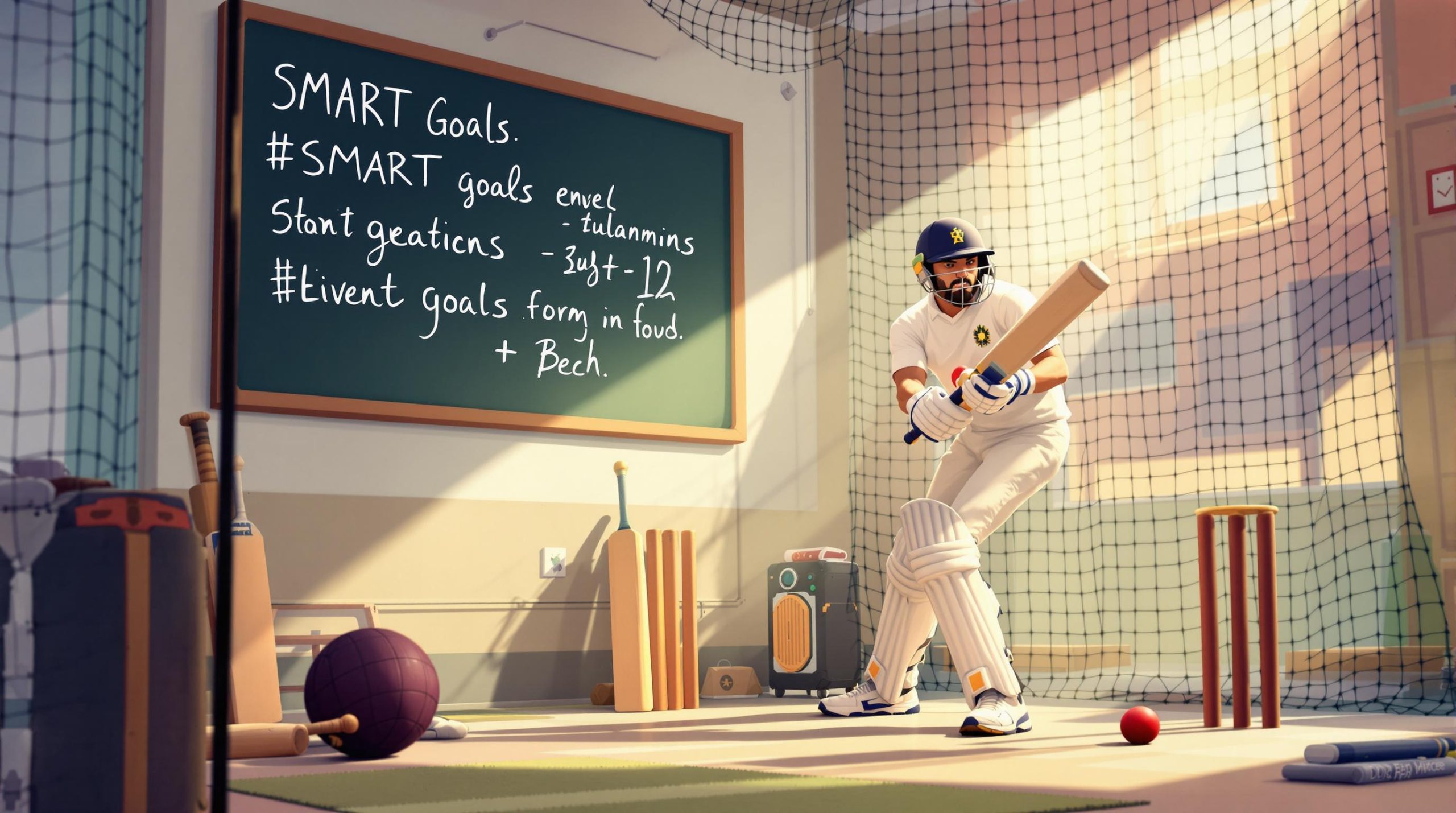
Want to make your short net sessions count? Here’s how:
- Set Clear Goals: Focus on specific skills like batting against inswingers or bowling consistent yorkers.
- Use SMART Goals: Make them Specific, Measurable, Achievable, Relevant, and Time-bound (e.g., hit 8/10 front-foot drives on target).
- Plan Your Session: Divide your time into warm-up, skill drills, and match-like scenarios. For example, a 30-minute session could include:
- 5 mins: Warm-up
- 15 mins: Main skill focus
- 7 mins: Pressure drills
- 3 mins: Cool-down
- Track Progress: Use quick notes, video clips, or session ratings to monitor improvement.
- Adjust Regularly: Update your goals every 4-6 sessions based on performance.
Key takeaway: A structured plan with specific goals can turn even a 20-minute practice into a productive, game-ready session.
Drill to Improve Batting in Cricket Nets
1. Check Your Current Skills
Take a close look at your skills to find areas that need improvement during your short net sessions.
How to Review Your Skills
Go over your recent matches and practice sessions. Pay attention to both what you’re good at and where you struggle consistently. Keeping a practice diary can help you track specific parts of your technique.
For batting:
- Write down how you’ve been getting out in recent games.
- Identify the types of deliveries that give you trouble.
- Track your scoring zones and favorite shots.
- Evaluate your footwork under different conditions.
For bowling:
- Check how consistent your line and length have been.
- Monitor the success rate of your variations.
- Look at your control in different conditions.
- Review the rhythm of your run-up and delivery.
Pick Your Focus Areas
After reviewing your performance, pick one or two specific skills to work on during your short net session. Concentrating on fewer areas will yield better results than trying to improve everything at once.
How to choose your focus:
- Prioritize skills that directly impact your match performance.
- Start with the basics before moving to advanced techniques.
- Factor in your current form and confidence levels.
- Choose areas that are manageable within a short session.
For instance, if you’re a batter struggling with inswinging deliveries, spend your 30-minute session practicing against those instead of spreading your attention across multiple shots. Bowlers could focus solely on nailing a consistent length rather than juggling different variations.
Zeroing in on one or two skills helps build consistency and muscle memory. Once you’ve identified your focus, you can set SMART goals for your practice.
2. Create SMART Practice Goals

Turn your focus areas into SMART goals – Specific, Measurable, Achievable, Relevant, and Time-bound. These goals will guide every drill during your net sessions, ensuring your practice is purposeful and effective.
Set Clear, Measurable Targets
Your goals should have specific and measurable outcomes. Vague objectives like "improve yorkers" won’t cut it. Instead, aim for precise, trackable results.
Examples of measurable batting goals:
- Hit 8 out of 10 front-foot drives between mid-off and mid-on
- Successfully defend 12 out of 15 incoming deliveries
- Score runs in designated areas for 7 out of 10 balls faced
- Play 5 consecutive pull shots with proper footwork
Examples of measurable bowling goals:
- Land 6 consecutive deliveries on a good length
- Bowl 4 out of 6 yorkers within 6 inches of the batting crease
- Hit the same spot on the pitch 5 times in a row
- Deliver three slower balls that dip under the bat
These types of targets make your practice more structured and game-relevant.
Make Goals Match-Ready
Practice should prepare you for real match scenarios. Adapt your targets to reflect what you’ll face in a game.
For batters:
- Work on scoring options against common field settings
- Practice rotating the strike in the first 3 balls of each over
- Focus on boundary options for the last 2 deliveries
- Simulate pressure situations with specific run requirements
For bowlers:
- Visualize field placements to align with your bowling plans
- Practice death bowling with specific boundary dimensions in mind
- Work on variations tailored to match conditions
- Target areas that challenge typical field setups
This approach connects your practice drills to actual game demands.
Fit Goals to Short Sessions
Break your practice into manageable chunks that fit your schedule. For a 20-minute session, here’s an example breakdown:
| Time Block | Focus | Specific Goal |
|---|---|---|
| 5 minutes | Warm-up | Complete stretches and 10 shadow drills |
| 10 minutes | Primary | Hit your main target (e.g., 8/10 deliveries) |
| 5 minutes | Variation | Practice alternate strategies or recovery |
Focus on one main goal during each session. It’s better to master one skill than to spread your effort too thin. Consistency and targeted effort are key to improving over time.
sbb-itb-3e44755
3. Plan Your Net Session
With your SMART goals in place, make every minute count by structuring your session effectively.
Quick Warm-Up Guide
Start with a 5-minute warm-up to reduce the chances of injury and get your body ready. Focus on dynamic stretches that target key cricket muscles:
- Upper body: Arm circles and shoulder rotations (30 seconds)
- Core and back: Trunk rotations and side bends (1 minute)
- Lower body: Lunges and leg swings (1 minute)
- Cricket-specific: Shadow batting or bowling (2.5 minutes)
Divide Your Practice Time
Break your session into focused segments to stay sharp. Here’s a suggested plan for a 30-minute session:
| Time Block | Activity | Focus Points |
|---|---|---|
| 5 minutes | Warm-up | Dynamic stretches to prepare your body |
| 15 minutes | Primary skill | Focus on your main technical goal |
| 7 minutes | Pressure drill | Practice game-like scenarios |
| 3 minutes | Cool-down | Stretch and reflect on the session |
For a shorter 20-minute session, you can try a 3-10-5-2 split. This structure helps you transition smoothly into match-like conditions.
Practice Game Scenarios
Bring your match goals to life by working on realistic game situations:
For Batters:
- Use cones or markers to set up virtual field positions.
- Practice strike rotation in the first three balls.
- Simulate challenging run rates, like needing 12 runs from 4 balls.
- Work on strategies to counter specific bowling plans.
For Bowlers:
- Mark target areas on the pitch for accuracy.
- Bowl full overs with realistic field placements.
- Practice delivering variations in a planned sequence.
- Aim for specific economy rate goals.
Keep track of these challenges to refine your sessions and improve over time.
4. Check and Update Goals
Track Your Progress
Keeping tabs on your progress helps you see what’s working and what needs improvement. Stick to simple, consistent methods for tracking:
Key Performance Metrics:
- Count successful attempts (like yorkers hitting their mark or drives finding gaps).
- Measure execution speed (time from delivery to release or backswing to contact).
- Monitor accuracy percentages for specific skills.
Ways to Document Progress:
- Quick Notes: Write down key stats in a notebook right after practice.
- Video Clips: Record short 30-second videos of specific techniques for review.
- Session Ratings: Score your performance on a scale of 1-10 for each goal.
| Tracking Method | Best For | Time Needed |
|---|---|---|
| Quick Notes | Small technical tweaks | 1-2 minutes post-session |
| Video Clips | Correcting form | 5 minutes during breaks |
| Session Ratings | Overall improvement | 30 seconds post-session |
Use this data to fine-tune your practice goals for future sessions.
Update Your Goals
Your tracked data is the foundation for refining your targets. Regularly updating your goals ensures your practice stays relevant and effective. Aim to revisit and adjust goals every 4-6 sessions.
When to Adjust:
- You’re consistently hitting your targets.
- Progress has plateaued.
- Feedback from matches highlights new areas to work on.
- Changes in technique require a shift in focus.
How to Adjust Goals:
- Review your current success rates.
- Increase difficulty by 10–15% when goals are consistently achieved.
- Break down complex objectives into smaller, measurable steps.
- Incorporate match-specific elements into already-mastered skills.
Examples for Progression:
-
Batting:
- Basic: Middle 6 out of 10 drives.
- Advanced: Score 4 runs per over.
- Match-ready: Rotate strike within the first 3 balls.
-
Bowling:
- Basic: Land 7 out of 10 deliveries on target.
- Advanced: Bowl 4 out of 6 yorkers accurately.
- Match-ready: Execute 2 change-ups per over.
Summary
To get the most out of your short net sessions, you need a clear plan and focus. Here are some practical tips to make your practice time count:
- Assess your skills: Start by evaluating your current cricket abilities to pinpoint areas that need work.
- Set clear goals: Use SMART goals (Specific, Measurable, Achievable, Relevant, Time-bound) to break complex skills into smaller, manageable targets that fit your session.
- Plan your session: Include a proper warm-up, allocate time for each focus area, and practice scenarios you might face in a game.
- Track your progress: Use simple methods to monitor improvements and adjust your goals as needed.
With these steps, you can make every session productive and see steady improvement.